
Saint Augustine of Hippo: The Doctor of Grace and Patron of Theologians
Explore the life, conversion, and enduring legacy of Saint Augustine, Bishop of Hippo and Doctor of the Church. Learn about the impact of his works on Catholic theology and his importance as the patron of students and philosophers.
SAINTS
Rodrigo Oliveira
12/4/2025
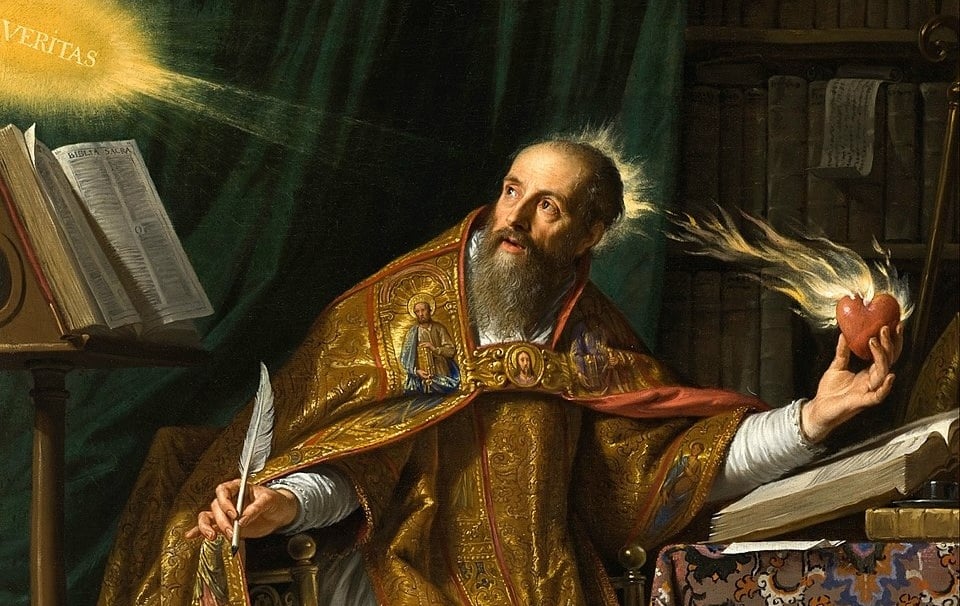
Augustine, or Aurelius Augustinus, is one of the most monumental figures in Christian history. Born in 354 A.D. in Tagaste (modern-day Algeria), he followed an intellectual and spiritual journey that led him from skepticism and worldly passions to become one of the greatest luminaries of the Church: Saint Augustine of Hippo. His vast literary output established the pillars of Western theology, and he is rightly revered as the Doctor of Grace.
Life Story: The Relentless Search for Truth
Augustine's life is an eloquent testimony to the human search for truth and the transformative power of grace. The son of Patricius, a pagan (who converted on his deathbed), and Monica, a fervent Christian (now Saint Monica), Augustine received a superb education, excelling in rhetoric.
A Turbulent Youth: His youth in Carthage was marked by an intense intellectual life, but also by a disordered pursuit of pleasures. He lived in concubinage and adhered to Manichaeism, a dualistic sect that attempted to solve the problem of evil, causing great suffering to his mother.
The Intellectual Journey: Dissatisfied with Manichaean answers, he moved to Rome and then to Milan, where he secured a prestigious position as a professor of rhetoric. It was in Milan that the providential encounter occurred.
The Meeting with Ambrose: The preaching of Bishop Saint Ambrose revealed to him a new and profound way to interpret the Scriptures, opening him up to the Christian faith.
Conversion and Baptism: The culminating moment of his conversion is recounted in his famous Confessions. In a garden, afflicted by doubts, he heard a child's voice saying "Tolle, lege!" (Take up and read!). Opening the Bible, his eyes fell upon Romans 13:13-14, which prompted him to an immediate decision to break with his undisciplined life. He was baptized by Saint Ambrose in 387 A.D.
After his mother's death, Augustine returned to Africa and founded a monastic community. In 391, he was ordained a priest, and in 395, he became the Bishop of Hippo, where he dedicated the rest of his life to pastoring, combating heresies, and producing his immortal works.
Miracles: Transformation by Grace
Although the hagiography of Saint Augustine does not center on spectacular miracles of healing or physical wonders like other saints, the Church recognizes a miracle of a much deeper and foundational order: the miracle of conversion and the testimony of his life as a miracle of God's grace.
The Miracle of Conversion: Augustine himself viewed his transformation from a proud intellectual and sinner into a Doctor of the Church as the greatest proof of God's action. His Confessions are an account of the struggle between human will and divine attraction, where grace triumphs. The persistent prayer of Saint Monica for 33 years is, for Tradition, the manifestation of providence that culminated in this "personal miracle."
Miracles of Intercession: Since his death, countless faithful have attributed to Saint Augustine intercession in cases of intellectual doubt, crises of faith, and, significantly, in matters related to the search for truth and purity of life.
Importance to the Catholic Church
Saint Augustine's contribution to the Catholic Church and to all of Western civilization is inestimable. He is one of the four original Doctors of the Western Church, alongside Saint Jerome, Saint Ambrose, and Saint Gregory the Great.
Foundational Works: His masterpieces, The City of God and Confessions, continue to be studied.
Confessions: It is the first great example of a spiritual autobiography, a profound dialogue about the soul's relationship with God.
The City of God: Written in response to the sack of Rome, it presents a profound philosophy of history, distinguishing the Earthly City (founded on self-love) from the City of God (founded on the love of God).
Doctrine of Grace: His greatest theological struggle was against Pelagianism, which denied the necessity of divine grace for salvation. Augustine vehemently defended that human beings cannot achieve salvation through their own merits alone, and God's grace is absolutely necessary (hence his title, Doctor of Grace).
Patronage: He is the patron saint of theologians, philosophers, printers, and various religious orders, including the Order of Saint Augustine (Augustinians).
Curiosities and Popular Devotions
Devotion to Saint Augustine is universal in the Church, as he is a model of repentance and wisdom.
The Flaming Heart: Augustine's iconography often depicts him holding a flaming heart, symbolizing the fervor of his faith and the famous quote: "You have made us for yourself, O Lord, and our heart is restless until it rests in you."
The Mystery of the Trinity: A popular tradition relates that while meditating on the mystery of the Most Holy Trinity by the seashore, Augustine saw a child attempting to empty the ocean into a hole in the sand with a seashell. When asked what he was doing, the child replied that he was attempting the impossible, implying that the mystery of God is immeasurable to the human mind.
Liturgical Feast: The feast of Saint Augustine of Hippo is celebrated on August 28th, the date of his death in 430 A.D., while the Vandals were besieging Hippo.
Prayer to Saint Augustine
O, Saint Augustine, Doctor of Grace and Truth, who found rest for your heart in God, pray for us. Intercede that divine grace may illuminate us, keep us away from error, and guide us in the unceasing search for the Truth which is Christ. Amen.
© 2025 A Catequese. All Rights Reserved.
We are dedicated to spreading the Catholic Faith, sharing the power of prayer, and preserving the inspiring stories of the saints.
If our work has touched your heart or deepened your spiritual journey, please consider making a contribution. Your support is crucial for covering the costs of this ministry, allowing us to publish more free resources and guides.
Any amount helps us keep the faith alive online!