
Saint Cecilia: The Patroness of Music and Martyr of Unwavering Faith
Discover the life of Saint Cecilia, an early Church martyr and patroness of musicians. Learn her story of faith, chastity, and martyrdom in Rome.
SAINTS
Rodrigo Oliveira
11/8/2025

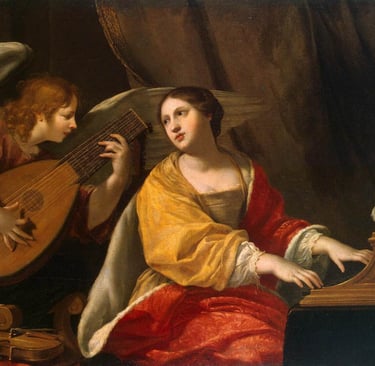
Among the most inspiring female figures of the early Church, Saint Cecilia stands out. She was a Roman noblewoman who lived between the 2nd and 3rd centuries. Her story, wrapped in accounts of deep piety and heroic resistance, has immortalized her as a symbol of unwavering faith in the face of persecution. Popular tradition and art have consecrated her as the Patroness of Music, an association that originates from the description of her profound inner devotion. Her testimony of chastity and her martyrdom in Rome, at the heart of the Empire, offer a powerful reminder of the courage needed to live the Gospel in adverse times.
Life Story: Consecrated Chastity and Conversions
Cecilia was born into one of the most distinguished families in Rome. From her youth, she consecrated her virginity to God, a vow she kept secret beneath the sumptuous garments of her social class. When her parents promised her in marriage to the young pagan nobleman, Valerian, Cecilia accepted the marriage, but with a spiritual resolve.
On her wedding night, young Cecilia revealed her vow of chastity to Valerian, stating that an angel of God watched over her and protected her. She challenged him to respect her vow, and if he wished to see the angel, he should be baptized by Pope Urban I, who was hiding in the catacombs due to persecution.
Valerian, deeply moved by Cecilia's conviction and the light of her faith, granted her request. After his baptism, Valerian returned and saw, next to his wife, a radiant angel who placed crowns of roses and lilies, symbols of chastity and martyrdom, upon both their heads. Valerian, in turn, converted his brother, Tiburtius. Together, the three devoted themselves fervently to charitable works, especially burying the bodies of Christian martyrs.
Miracles and the Origin of Musical Patronage
Although the legend of Saint Cecilia is rich in miraculous elements, two aspects are particularly notable:
The Vision of the Angel: The conversion of Valerian and Tiburtius through the vision of the angel is the central miracle of the story, demonstrating the power of Cecilia's faith.
The Patronage of Music: The association of Saint Cecilia with music is not due to a miracle of healing but to a poetic passage in her Passion (martyrdom account). Tradition states that while the nuptial instruments (organs and flutes) resounded during her wedding, Cecilia sang in her heart, directing her soul to God: “May my heart and my body, O Lord, be kept unstained, so that I may not be confounded”. This 'inner music,' the melody of her devoted soul, made her the Patroness of Musicians, poets, instrumentalists, and all who seek beauty and harmony in art.
Importance for the Catholic Church: The Triumph of Chastity and Witness
The martyrdom of Saint Cecilia, which occurred under Emperor Alexander Severus or Marcus Aurelius, reinforced the morale and courage of early Christians.
Fidelity to Vocation: Her life is a powerful testimony to the value of consecrated chastity and fidelity to the baptismal vow, even under the pressure of social obligations.
Courage in Persecution: The story of Cecilia—as well as that of Valerian and Tiburtius—inspires the defense of faith even if it costs one's life. The three were arrested for refusing to worship the Roman gods and for burying the Christian martyrs.
The Final Martyrdom: After the execution of her husband and brother-in-law, Cecilia was detained. Authorities attempted to suffocate her in a boiling bath, but she remained unharmed. Next, an executioner was sent to decapitate her. Tradition reports that he struck her three times on the neck but failed to separate her head from her body. She remained alive for three days, preaching the Gospel and distributing her goods to the poor before finally passing away.
Pope Urban I buried her body in the Catacomb of Callistus, and later, in the 9th century, Pope Paschal I translated her to the Basilica of Saint Cecilia in Trastevere, where her relics rest to this day. When her tomb was opened in 1599, her body was found incorrupt, in the same position in which it was buried: lying down, with her face turned towards the ground, arms crossed, and three visible cuts on her neck, a spectacle that moved Rome and attested to the veracity of her martyrdom.
Curiosities and Devotional Legacy
Basilica in Trastevere: The Basilica of Saint Cecilia in Trastevere was built over what is believed to have been Cecilia's house and has become one of the oldest places of worship in Rome.
The Incorrupt Sculpture: The marble statue of Saint Cecilia in the Basilica, crafted by sculptor Stefano Maderno (1600), portrays the body exactly as it was found: lying down and with the cuts on the neck. This work is one of the most famous icons in sacred art.
Musical Celebrations: Her feast day is widely celebrated around the world with concerts, solemn masses, and music festivals in her honor, especially by orchestras and choirs.
Final Reflection and Prayer
Saint Cecilia invites us to harmonize faith and life, to make our body and soul a "tuned instrument" for God. Her courage in defending her chastity and her faith, even in the face of death, is a hymn of strength and purity that resonates through the centuries.
Prayer to Saint Cecilia:
"O glorious Saint Cecilia, who joined your virginity to the fervor of faith and the ardor of martyrdom, protect us from all evil. Grant that our lives may be a pleasant melody to God and that, through your intercession, we may one day praise Him forever in Heaven. Amen."
© 2025 A Catequese. All Rights Reserved.
We are dedicated to spreading the Catholic Faith, sharing the power of prayer, and preserving the inspiring stories of the saints.
If our work has touched your heart or deepened your spiritual journey, please consider making a contribution. Your support is crucial for covering the costs of this ministry, allowing us to publish more free resources and guides.
Any amount helps us keep the faith alive online!