
Saint Lucy of Syracuse: The Beacon of Faith and the Story of the Patroness of Eyes
Explore the history of Saint Lucy, the virgin and martyr of Syracuse and the miraculous Patroness of Eyes. Learn about her life, her martyrdom during the Diocletianic Persecution, and her profound relevance as a symbol of Christ's light in the Church.
SAINTS
11/29/2025
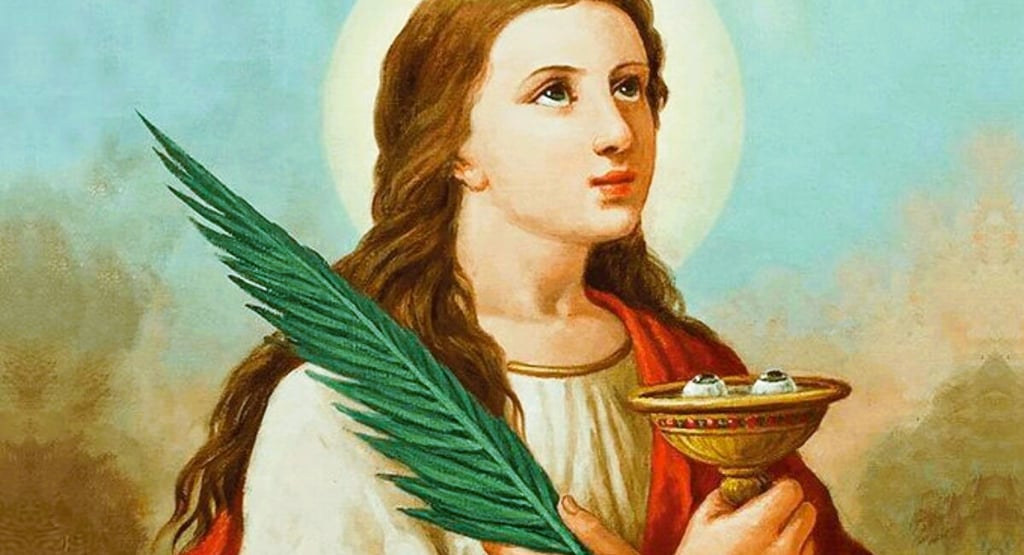
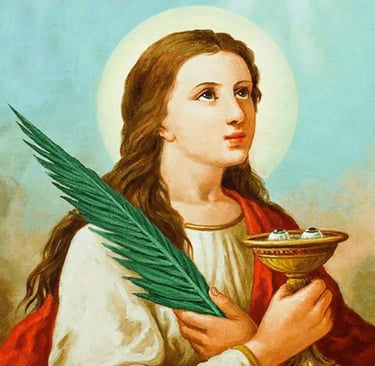
In the firmament of Christian sanctity, Saint Lucy—whose name derives from the Latin lux, meaning "light"—radiates as one of the most moving testimonies of the early faith. Born in Syracuse, Sicily, in the late third century, this virgin and martyr represents the unwavering courage of a Christian who preferred the ultimate sacrifice to the denial of her faith. Her liturgical feast, celebrated on December 13th, marks a high point of popular devotion and is particularly significant due to her invocation as the Patroness of Eyes and Sight. Her story is not merely a tale of martyrdom but a powerful reminder of the light of Christ that illuminates the darkness of the world.
Life Story: The Virgin of Syracuse
Lucy (or Lucia) came from a wealthy and noble Sicilian family. Her father died when she was very young, leaving her in the care of her mother, Eutychia. Early on, Lucy took a secret vow of chastity, dedicating her life to God and aspiring to a life of assisting the poor.
The historical context in which Lucy lived was that of the feared persecution of Christians under the Emperor Diocletian. Her mother, unaware of her daughter's vow, planned to marry her to a pagan youth. Eutychia suffered from a severe hemorrhage, and Lucy convinced her to make a pilgrimage to the tomb of Saint Agatha in Catania, a highly venerated martyr in Sicily.
At the Saint's tomb, Lucy and her mother prayed fervently. Lucy had a vision in which Saint Agatha announced Eutychia's healing, stating: "Lucy, my sister, why do you ask of me what you yourself can obtain for your mother? Since your faith has pleased God, behold, your mother is cured. And just as the Lord honored the city of Catania through me, He will honor your city of Syracuse through you."
Miraculously healed, Eutychia consented to Lucy donating her wealth to the poor and living her life in chastity. However, the rejected fiancé, enraged by Lucy's refusal and the donation of her inheritance, denounced her to the Roman authorities as a Christian.
The Martyrdom and the Response of Faith
Lucy was brought before the judge Paschasius. During the interrogation, she displayed admirable eloquence and courage, defending her faith and her decision to live for Christ. Hagiographical tradition narrates that the judge, trying to break her determination, threatened to take her to a place of dishonor. Lucy responded that her body would remain pure through the grace of God.
The account of her martyrdom is marked by supernatural events. When the guards attempted to drag her away, she remained immovable. Not even a team of oxen could move her, a sign of the divine power protecting her. Humiliated and furious, Paschasius ordered her to be burned. However, the fire did not consume her. Finally, she was killed by the sword, with a spear plunged into her throat, but not before uttering prophecies about the fall of Diocletian and the end of the persecutions.
Miracles and the Patroness of Sight
Although the Church primarily focuses on Lucy's faith and martyrdom, popular devotion strongly links her to the healing of eyes. The origin of this association is debated:
Light of the Name: The most accepted and theologically rich connection comes directly from her name, Lucy (Lucia), meaning "light," and she is invoked for both physical and spiritual sight.
Iconographic Tradition: A later tradition, reflected in many works of art, narrates that Lucy had her eyes gouged out or removed them herself, offering them to the judge to prove her unbreakable vow of chastity and dedication to Christ. In response, God is said to have rewarded her with new, even more beautiful eyes. Modern iconography often depicts her holding a plate with two eyes.
Regardless of the specific origin, Lucy's central miracle is that of the unwavering faith that allowed her to see eternal glory, even in the face of the darkness of martyrdom. Therefore, the Church invokes her to intercede for the physical health of the eyes and for the clarity of spiritual vision needed to discern God's will.
Importance to the Catholic Church: Symbol of Pure Faith
Saint Lucy is one of the few martyr saints honored by mention in the Roman Canon (Eucharistic Prayer I), attesting to the antiquity and universality of her cult in the Church. Her life is a pillar of hagiography, reinforcing essential values:
Chastity and Vow: Her martyrdom confirms the supreme value of consecration to God, even in the face of social and familial pressures.
Charity: The donation of her wealth to the poor is a model of evangelical detachment and prioritizing the Kingdom of God.
Doctrine of Light: As Lucy, she symbolizes that the true light of the world is not the sun, but Christ, whom she followed unto death. Her testimony is a beacon against paganism and incredulity.
Popular Devotions and Legacy
In many cultures, Saint Lucy's Day, December 13th, coincides with the time of year when darkness lengthens in the northern hemisphere. This reinforces her image as the one who brings spiritual light amidst the darkness of winter. Devotion to the Saint spread rapidly throughout Europe, especially in Scandinavia, where she is celebrated with festivities involving crowns of candles. In Portugal and Brazil, the Novena of Saint Lucy is a popular means of prayer for vision problems and to ask for the grace to see the world with the eyes of faith.
Conclusion and Prayer
Saint Lucy of Syracuse remains an eloquent example of the triumph of faith over worldly force. Her story invites us to ask God not only for the physical health of our eyes but, above all, for the grace of a clear spiritual vision, capable of recognizing Christ in every brother and in His Word. She is the light that does not fade.
Prayer to Saint Lucy
O Glorious Saint Lucy, who preferred to have your eyes gouged out rather than deny the Faith and stain your soul; by the power God has granted you, preserve our sight and our faith. Grant that the light of our eyes may always illuminate the path of our life and help us to see God and His Word with the clarity of the soul. Amen.
© 2025 A Catequese. All Rights Reserved.
We are dedicated to spreading the Catholic Faith, sharing the power of prayer, and preserving the inspiring stories of the saints.
If our work has touched your heart or deepened your spiritual journey, please consider making a contribution. Your support is crucial for covering the costs of this ministry, allowing us to publish more free resources and guides.
Any amount helps us keep the faith alive online!